ProcessMaker vs Process Street for Enterprise Workflow Automation
Your team needs to pick between ProcessMaker and Process Street right now because both platforms claim to handle enterprise workflow automation and you have a decision to make before the next quarter begins. Some tools start with workflow design and add compliance later; others start with compliance and layer automation on top.
By the end of this article, you will know exactly how each platform handles audit-ready workflows and AI policy enforcement, what the pricing differences are, and which one fits your compliance requirements and automation needs without further research.
Quick Verdict: ProcessMaker vs Process Street for Enterprise Workflow Automation
Process Street delivers SOC 2 Type II certified, ISO 27001 compliant automation while ProcessMaker focuses on general-purpose BPM without comparable certification claims.
Enterprise teams face strict regulatory requirements that demand proven security standards and fast deployment. Process Street meets these needs through its established compliance framework.
Organizations gain immediate value from certifications that include HIPAA, GDPR, and CCPA compliance. These standards eliminate lengthy security reviews that often delay implementation projects.
Setup efficiency becomes another decisive factor for enterprise workflow automation. Process Street achieves reduction in setup time based on real customer implementations like IMCD UK.
The platform serves over 3,000 companies and 1 million users who rely on these security and speed advantages. This proven track record provides confidence for regulated industries seeking reliable workflow solutions.
ProcessMaker lacks equivalent certification documentation for enterprise security requirements. This gap creates additional risk and complexity for organizations operating under strict compliance mandates.
At a glance: how Process Street compares to ProcessMaker, Process Street for Enterprise Workflow Automation on the features that matter most.
| Feature | Process Street | ProcessMaker | Process Street for Enterprise Workflow Automation |
|---|---|---|---|
| Enterprise Workflow Automation | ✓ | ✓ | ✓ |
What Is Process Street?
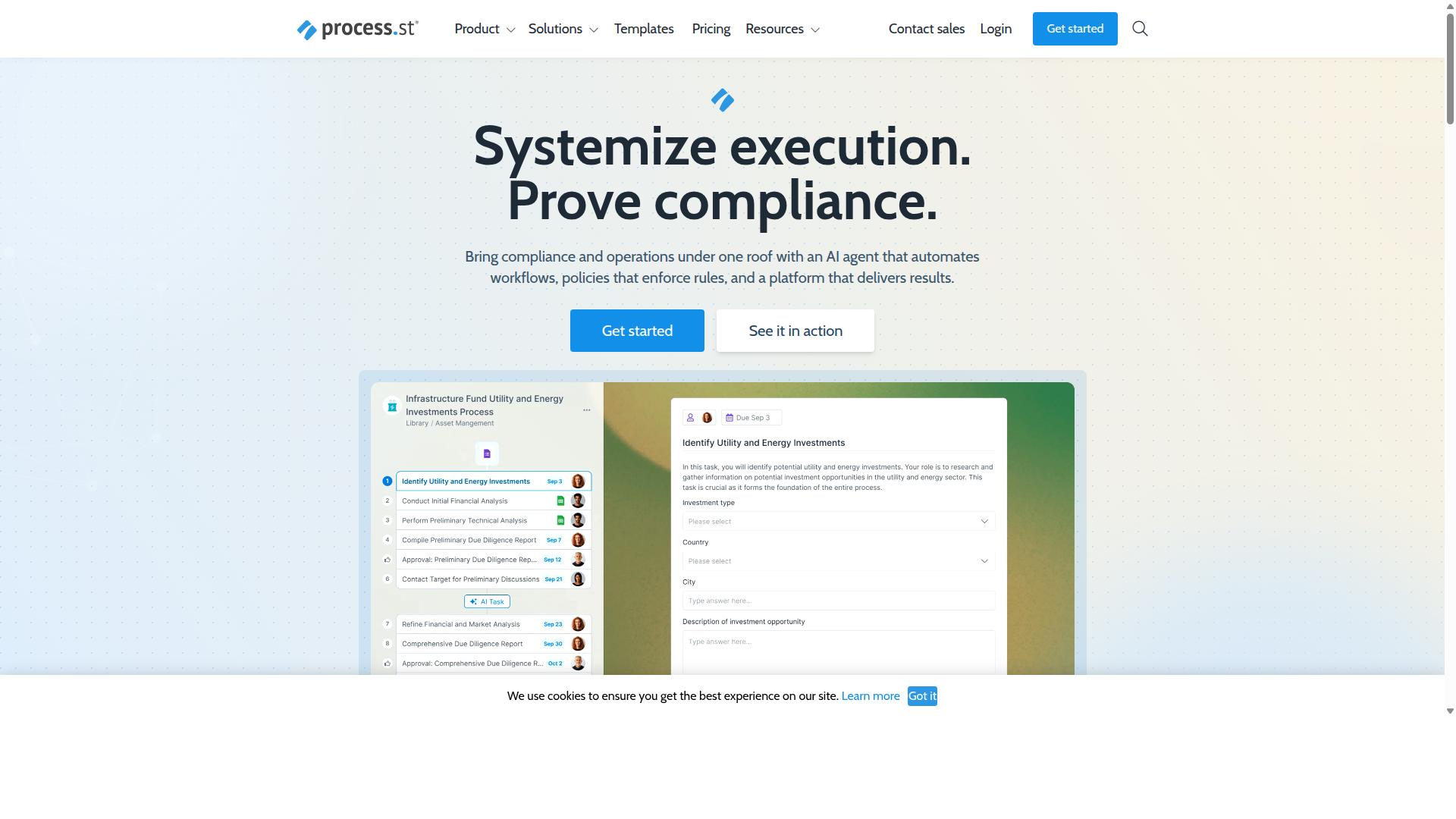
Process Street is a compliance operations platform that automates business processes, enforces policies, and delivers audit-ready proof through three integrated products.
The platform combines document management with workflow automation to help enterprises maintain operational consistency. Organizations use it to standardize processes while generating the proof needed for compliance audits.
Three products work together to support enterprise workflow automation. Docs handles document management and policy control. Ops manages workflow automation and process orchestration. Cora serves as an AI compliance and risk agent.
Process Street focuses on proving compliance while maintaining operational consistency. This approach differs from general BPM platforms that may prioritize automation alone without built-in compliance features.
Enterprises across industries rely on the platform to enforce policies through structured workflows. The integrated product suite provides a single source for both process execution and compliance documentation.
What Is ProcessMaker?
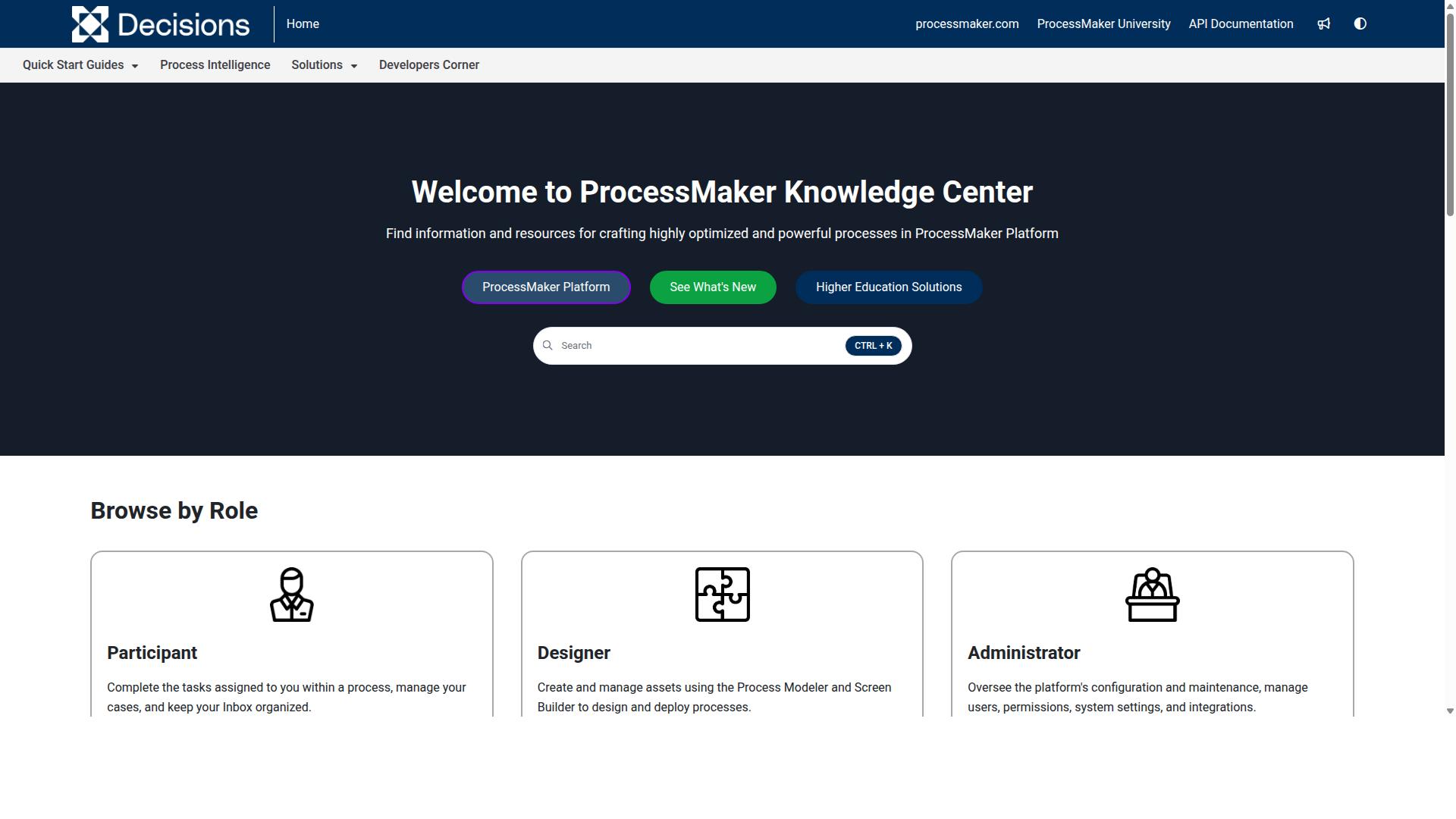
ProcessMaker is an open-source BPM platform that supports both cloud and on-premise deployments for organizations seeking customizable workflow management.
Many enterprises choose this tool when they require full control over their workflow infrastructure. The platform offers flexibility for teams that want to adjust their process automation systems to meet specific internal requirements.
ProcessMaker uses a business rules engine to handle complex decision-making within workflows. This allows organizations to create dynamic approval workflows that adapt based on predefined conditions.
The platform includes form builder functionality for designing custom data collection interfaces. Teams can map out their processes using visual design tools that support conditional logic and branching paths.
ProcessMaker provides API integration capabilities for connecting with existing enterprise systems. This enables organizations to extend their workflow orchestration across different software environments.
The tool supports role-based access controls to manage user permissions across process stages. Organizations can also set up escalation paths when tasks exceed defined time thresholds.
What Is Process Street for Enterprise Workflow Automation?
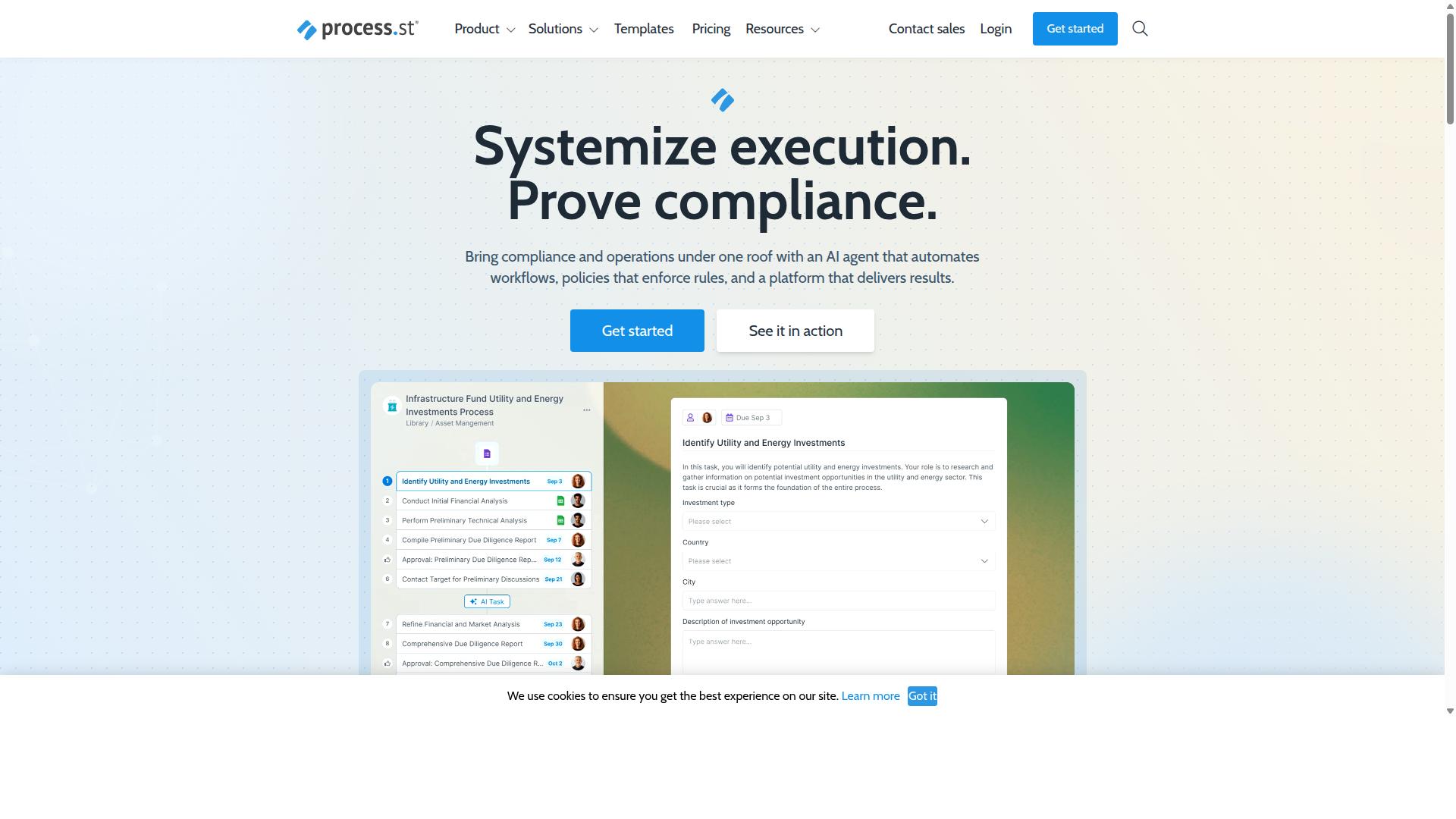
Process Street's Ops product turns policies into AI-powered workflows that orchestrate tasks, approvals, and escalations across the enterprise. The platform converts documented procedures into automated sequences that handle routine work without manual intervention.
Ops connects directly to enterprise compliance requirements through Docs, which provides document management with full governance support for ISO 9001, SOC 2, SOX, and FDA standards. Organizations maintain policy versions while the system ensures workflows reflect current requirements.
Process AI monitors workflow execution and identifies patterns that improve efficiency. Automations handle repetitive actions, while Analytics provide visibility into process performance across departments.
The platform includes Apps that extend functionality and Integrations that connect with existing enterprise systems. Organizations use Zapier, Microsoft Power Automate, Tray.io, Make, and public API access to build connections between Process Street and their current technology stack.
Cora operates as an AI compliance agent that monitors regulations continuously. The agent automates compliance work and flags potential risks before they become issues, reducing the manual effort required for audit preparation.
This approach differs from ProcessMaker's traditional BPM platform model. Process Street focuses on turning existing policies into executable workflows rather than requiring teams to design processes from scratch in a separate modeling environment.
Features Compared
The following comparison examines the specific capabilities that matter most for regulated enterprises evaluating workflow automation platforms.
Enterprise teams need systems that deliver consistent policy enforcement while meeting strict compliance and governance requirements. Both platforms offer workflow automation, but their approaches to documentation control and regulatory alignment differ significantly.
ProcessMaker and Process Street provide BPM capabilities, yet the depth of built-in governance tools varies. This matters most when organizations must maintain audit-ready records across multiple regulatory frameworks.
Teams evaluating these options typically focus on three areas: compliance documentation handling, automated policy enforcement, and integration flexibility with existing enterprise systems.
Compliance & Audit-Ready Workflows
Process Street's Docs product provides full governance for ISO 9001, SOC 2, SOX, and FDA requirements with automatic audit trail generation.
Document management and policy control become critical when organizations face external audits or regulatory reviews. Process Street maintains version control across all policy documents while generating the required documentation automatically.
ProcessMaker offers workflow automation features, but the specific compliance frameworks supported depend on custom configuration rather than built-in governance capabilities. Enterprises must often build additional documentation layers to meet the same regulatory standards.
Role-based access controls help ensure that only authorized personnel can modify policies or access sensitive workflow data. This reduces risk during compliance reviews and maintains consistent oversight across distributed teams.
Version control features track every policy change with timestamps and user attribution. Audit-ready documentation emerges naturally from daily operations rather than requiring separate manual compilation processes.
AI-Powered Automation & Policy Enforcement
Process Street's Ops product uses AI to enforce policies automatically, reducing manual compliance checks while maintaining SLA tracking and escalations.
Process AI converts static policy requirements into active workflow rules that trigger actions without human intervention. This approach reduces the risk of oversight while maintaining consistent compliance across all processes.
ProcessMaker provides workflow automation tools, yet the extent of AI-driven policy enforcement depends on custom development rather than platform-native capabilities. Teams may need additional configuration to achieve similar automated oversight levels.
Cora functions as an AI compliance agent that monitors regulations, automates work, and flags risks continuously. This creates proactive compliance management rather than reactive issue resolution after problems occur.
Automated escalations ensure that SLA violations receive immediate attention through predefined response protocols. Teams maintain visibility into compliance status without requiring constant manual monitoring of individual workflows.
Pricing Compared
Process Street offers three pricing tiers beginning with a simplified Startup plan that includes up to 5,000 Data Set records and 100 automation actions per month.
Enterprise buyers need clear cost structures and predictable scaling. Process Street presents three tiers that align with different organizational sizes and automation demands.
The Startup plan targets growing teams with unlimited workflows and tasks. This plan supports 5 users and 10 guests alongside 10 automation apps with 100 automation actions monthly and 50 Public API calls.
The Pro plan expands these limits significantly. Organizations gain up to 10,000 Data Set records with custom user counts and all automation apps available through custom monthly allocations.
Enterprise organizations require dedicated support and advanced capabilities. Process Street Enterprise delivers custom Data Set records, unlimited API access, and a dedicated Success Manager with priority support.
Enterprise customers also receive fully-managed workflows and custom integrations. Additional benefits include bulk document import, process consulting, health audits, and personalized team training programs.
ProcessMaker pricing structures vary by deployment model and organizational scale. Enterprise buyers typically encounter complex licensing arrangements depending on user counts and integration requirements.
Process Street Enterprise capabilities address key enterprise workflow automation needs without requiring separate infrastructure investments. The platform provides cloud-based access with role-based access controls and SSO authentication support.
Cost predictability matters for budget planning. Process Street offers transparent tier progression while ProcessMaker solutions often involve custom enterprise agreements with variable pricing components.
Who Should Choose Process Street
Teams in Operations, Compliance, HR, Finance, and IT at organizations requiring documented audit trails and policy enforcement should evaluate Process Street.
These departments often handle sensitive workflows that demand clear accountability and version control. Process Street serves these groups through its focus on documented processes and compliance requirements.
Several industries align with this platform's strengths. Financial services, healthcare, manufacturing, and professional services organizations frequently need the audit capabilities that Process Street provides.
Real estate companies, technology firms, capital markets, and property management businesses also benefit from structured workflow approaches. Each industry faces regulatory requirements that favor platforms with strong documentation features.
Common use cases include employee onboarding procedures, client onboarding sequences, and ISO compliance tracking. Quality management, document control, and custom workflow creation represent additional areas where teams find value.
Organizations choosing between platforms should consider their specific compliance needs. Process Street addresses scenarios requiring documented approval workflows and role-based access controls.
The platform supports teams that prioritize audit trails over other considerations. ProcessMaker may suit different requirements depending on technical infrastructure needs and deployment preferences.
Who Should Choose ProcessMaker
Organizations needing extensive on-premise customization or open-source flexibility may prefer ProcessMaker's general-purpose BPM approach.
Some enterprises operate under strict data residency requirements that mandate keeping workflows entirely within their own infrastructure. Others maintain legacy systems that require deep code-level modifications to integrate properly.
ProcessMaker offers a BPM platform that supports these types of environments. IT teams with strong development resources often find value in platforms that allow modifications down to the source code level.
Consider ProcessMaker when your organization already maintains significant technical infrastructure and dedicated development staff.
Teams that need to build custom connectors for proprietary systems may benefit from this level of flexibility. The open-source option allows organizations to audit code and modify behavior without vendor dependencies.
However, this approach typically requires more technical expertise to implement and maintain compared to cloud-native alternatives. Regular updates, security patches, and system monitoring fall entirely on internal teams.
Organizations evaluating workflow automation should weigh these technical demands against their available resources. Enterprise workflow automation needs vary significantly across industries and company sizes.
ProcessMaker may suit organizations that have already invested in on-premise infrastructure and possess the technical capacity to manage complex deployments. Companies prioritizing rapid implementation and lower maintenance overhead often explore other paths.
Who Should Choose Process Street for Enterprise Workflow Automation
Enterprises standardizing onboarding for 49,000+ employees and requiring SOC 2 Type II certified workflows should select Process Street. This platform delivers the scale and compliance needed for complex organizational requirements. Organizations managing distributed teams across multiple regions find particular value in these capabilities.
Companies running enterprise workflow automation initiatives benefit from Process Street when compliance documentation and audit trails become essential. The SOC 2 Type II certification combined with ISO 27001 and HIPAA compliance addresses regulatory demands that many BPM platforms handle inconsistently. Role-based access and approval workflows gain additional strength when backed by these verified security frameworks.
Teams previously struggling with process documentation find that Process Street reduces setup time significantly. Reports from IMCD UK indicate reduction in setup time after implementation. This efficiency gain proves especially valuable during enterprise migrations from legacy systems or manual processes.
Process Street serves organizations prioritizing data protection and privacy standards. The platform maintains GDPR compliance, CCPA compliance, and AWS CIS compliance. Data never used to train AI models addresses concerns around information security that arise during vendor evaluations.
Support responsiveness matters for enterprise deployments where workflow interruptions affect business operations. Process Street provides an average response time of five minutes with a 98% customer rating. These metrics demonstrate the platform's commitment to maintaining operational continuity during critical business processes.
Final Verdict
Process Street is the clear choice for regulated enterprises that need SOC 2 Type II certified automation and reduction in setup time.
ProcessMaker may work well for organizations seeking traditional BPM platforms with on-premise options. However, enterprises operating in regulated environments typically require certified security standards and faster implementation timelines.
The key differentiators come down to compliance certification, deployment speed, and ongoing support quality. Process Street delivers SOC 2 Type II certification as a baseline security requirement for many enterprise workflows.
Implementation time represents another significant advantage. Organizations using Process Street report setup times reduced compared to traditional approaches.
Support response times average 5 minutes with a 98% customer rating. This level of responsiveness matters when workflow issues could impact compliance or business operations.
Enterprises evaluating both platforms should contact Process Street sales directly to discuss specific requirements. The team can provide detailed comparisons based on your regulatory environment and workflow complexity.
Recommended Resources: