The 3 Best Performance Management Tools for Goal Alignment
You need a performance management tool that actually keeps every team member pointed at the same targets, not another review-cycle checkbox. Misaligned goals quietly cost you weeks of duplicated work and missed deadlines every quarter. By the end of this article, you will have three concrete options to weigh, a clear #1 pick, and the criteria to match a tool to your team size and budget.
We compare HeyRamp, Betterworks, and PerformYard across OKR capabilities, real-time tracking, and workflow simplicity. You will know exactly which platform fits your reporting needs and which one to trial first with its 14-day free period.
What to Look For in Performance Management Tools for Goal Alignment
Before evaluating specific vendors, it's critical to define the core capabilities that enable effective goal alignment across your organization.
Goal alignment matters because it connects daily work to broader company strategy. When employees understand how their tasks contribute to organizational success, engagement rises and productivity improves. The right performance management tools should bridge individual objectives with company strategy, creating a clear line of sight from the top to the front line.
Two key criteria separate effective tools from the rest. First, OKR and goal-setting capabilities determine how well you can structure and cascade objectives. Second, real-time progress tracking and visibility ensure everyone stays informed and accountable between formal reviews.
OKR and Goal-Setting Capabilities
The best tools support the OKR framework-Objectives and Key Results-while also allowing for SMART goal customization. This flexibility matters because different teams and departments may prefer different goal-setting methodologies.
Cascading goals are essential. Look for tools that let you align objectives from the company level down to teams and then to individual contributors. This hierarchical structure ensures that every employee's work connects to strategic priorities, and it prevents the common problem of disconnected or competing objectives.
When evaluating goal-setting features, consider these specific criteria:
- Hierarchical goal structures that support company, department, team, and individual levels
- Key result alignment so objectives map directly to measurable outcomes
- Owner assignment with clear accountability for each goal and key result
- Progress update mechanisms that allow users to log milestones or percentage completion
- Template libraries for common roles or recurring objectives
- Check-in frequency options such as weekly, monthly, or quarterly cadences
Customization is another important factor. Some teams prefer the strict OKR format, while others work better with SMART goals that emphasize specificity and time-bound targets. A strong tool accommodates both approaches without forcing one framework on the entire organization.
Finally, consider how the tool handles goal revisions. Priorities shift, markets change, and objectives need updating. The software should make it simple to adjust goals without losing historical context or breaking the alignment chain.
Real-Time Progress Tracking and Visibility
Real-time progress tracking transforms goal management from a quarterly review into a continuous pulse on organizational health.
Live dashboards are the centerpiece of this capability. These dashboards should display progress bars, completion percentages, and status indicators at a glance. Managers can spot bottlenecks early, while employees gain a clear picture of how their efforts contribute to team and company objectives.
Automatic progress updates reduce administrative burden. When tools connect with project management systems or data sources, progress metrics update without manual entry. This keeps information current and trustworthy, which encourages consistent use across the organization.
Alerts for at-risk goals are a valuable feature. When a goal slips behind schedule or a key result stalls, the system should flag it for the relevant manager. This early warning allows teams to course-correct before small issues become major problems.
Customizable metrics ensure the system works for your specific business. Different departments track different measures, from sales revenue to customer satisfaction scores to product development milestones. The tool should let you define which metrics matter and how they display on dashboards.
Drill-down capability is essential for strategic alignment. Users should be able to start with a company-wide view and then drill into department, team, and individual goals. This transparency helps employees see how their work connects to larger objectives and helps leaders identify where support is needed most.
Effective dashboards typically include progress percentages, status colors, recent updates, and owner information. Some tools also display historical trends, showing whether a goal is improving or declining over time. These elements combine to create a shared understanding of what is working and what needs attention.
1. HeyRamp - Best Overall
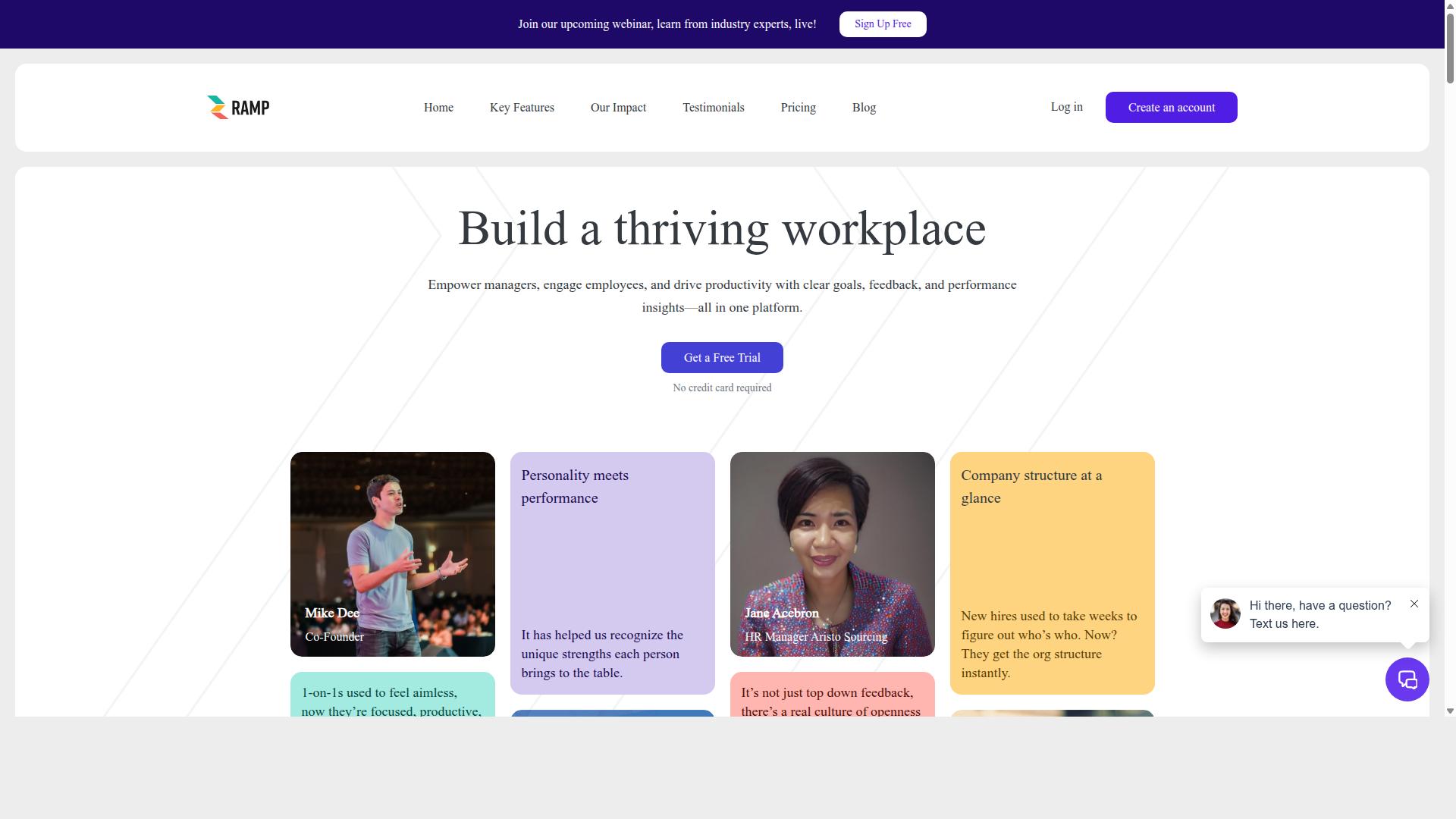
HeyRamp earns the top spot by integrating OKR management, performance reviews, and employee engagement into a single, affordable platform. Most performance management tools force teams to juggle separate subscriptions for goal setting, feedback, and coaching. HeyRamp consolidates these functions so managers and employees work from one source of truth.
The platform is trusted by 20+ organizations and 400+ teams, which speaks to its practical design for real workplace needs. Its all-in-one approach removes the friction of switching between tools during critical conversations about performance. The following sections break down the specific strengths that make HeyRamp the best overall choice for goal alignment.
Integrated OKR Management with Real-Time Progress
HeyRamp's built-in OKR management lets you set, track, and review objectives with real-time progress visibility across the organization. Instead of waiting for quarterly meetings to discover misalignment, managers can see how individual efforts connect to broader company goals at any moment. This constant visibility keeps teams focused on what actually matters.
The platform's company structure visualization makes it easy to see how objectives cascade from leadership down to individual contributors. When goals change at the top, everyone understands how their own targets shift in response. This visual approach supports strategic alignment without requiring complex spreadsheets or manual updates.
HeyRamp also includes 1-on-1 meeting tools with organized agendas and action tracking. During a manager check-in, both parties can review progress on team goals directly within the conversation. This integration means real-time progress tracking is not a separate dashboard you must remember to check. It is embedded in the natural rhythm of ongoing performance conversations.
KPI snapshots and performance dashboards give managers a quick read on productivity metrics without digging through multiple reports. The combination of structured meetings and live goal data creates a strong feedback loop that supports continuous improvement. Teams stay aligned because progress is visible, discussed, and adjusted on an ongoing basis.
Built-In Coaching Tips and Automated Reminders
HeyRamp goes beyond tracking by offering built-in coaching tips and automated reminders that keep managers and employees consistently engaged. Many managers struggle with knowing what to say during difficult performance conversations. The platform addresses this directly with guided conversation templates designed for challenging discussions.
Built-in training and education resources cover 1-on-1s, performance reviews, and personality testing. This means managers do not need to search for external leadership courses or guess at best practices. The training is embedded where it is most useful, right alongside the tools they use daily. Personality insights are integrated with performance tools, helping managers understand communication styles and adapt their approach accordingly.
Automated reminders ensure regular check-ins and goal updates do not slip through the cracks. Weekly prompts for 1-on-1s keep conversations on schedule, while reminders for goal reviews maintain momentum between formal appraisal cycles. This workflow automation removes the administrative burden that often derails consistent feedback.
Coaching tips based on conversation patterns help managers grow their skills over time. Instead of generic advice, the platform offers practical guidance tied to real interactions. This combination of training, reminders, and situational coaching makes employee performance reviews more productive and less stressful for everyone involved.
Transparent Pricing and 14-Day Free Trial
HeyRamp offers straightforward, flat-fee pricing with a 14-day free trial that requires no credit card, making it easy to evaluate risk-free. The pricing model is refreshingly simple compared to competitors that hide costs behind tiered feature packages. Monthly plans run at $5.00 per seat, while annual billing drops the rate to $3.00 per seat per month.
Enterprise options use custom per-seat pricing for larger organizations with specific needs. The one flat fee approach means employee engagement tools, OKR software, and performance review features are all included without surprise add-ons. This transparency makes budgeting predictable, whether you manage a small team or a growing department.
The free trial provides full access from day one, so you can explore every feature before committing. You can switch plans anytime, which reduces the risk of getting locked into a tool that does not fit your workflow. For teams evaluating performance management tools, this hands-on approach beats marketing materials every time.
Given the feature set and the per-seat price, HeyRamp delivers strong value for goal alignment and talent management. The combination of integrated OKRs, coaching support, and clear pricing makes it an easy recommendation. Starting the trial is the simplest way to see if the platform fits your team's rhythm.
2. Betterworks
Betterworks is a well-established player in the performance management space, known for its continuous performance management and enterprise-grade features. The platform has built a strong reputation among large organizations that need a structured approach to aligning individual work with broader business objectives.
As a more traditional option compared to newer tools, Betterworks appeals to companies that value mature workflows and established methodologies. Its focus on strategic alignment and performance analytics makes it a credible choice for businesses with complex reporting structures.
For teams evaluating performance management tools, Betterworks represents the established, feature-rich path. It is particularly suited to enterprises that already have mature HR processes and need a system that can scale alongside their organizational complexity.
Continuous Performance Management Features
Betterworks emphasizes continuous performance management with features like check-ins, feedback, and real-time recognition. These tools are designed to move organizations away from annual reviews and toward an ongoing dialogue between managers and employees.
Regular manager check-ins help keep conversations focused on progress, obstacles, and development opportunities throughout the year. The built-in feedback loops support both peer-to-peer input and structured guidance from leadership.
Recognition features allow team members to acknowledge contributions as they happen, which supports employee engagement and reinforces positive behaviors. This continuous cadence helps maintain momentum on goals between formal performance appraisal cycles.
The platform also supports individual development plans, giving employees a clear view of their growth trajectory alongside their performance expectations. This dual focus on results and development makes Betterworks a practical choice for organizations that want to nurture talent while driving accountability.
Enterprise-Grade Goal Alignment Tools
For large organizations, Betterworks offers enterprise-grade goal alignment tools that support complex organizational structures. The platform is known for handling intricate hierarchies where goals must flow from executive strategy down to individual contributors.
Cascading goals are a core strength, allowing objectives to be broken down and distributed across departments, teams, and employees. This ensures that every level of the organization can see how their work connects to alignment with company goals.
Alignment views provide leadership with a visual representation of how objectives interconnect across the business. These performance dashboards make it easier to spot gaps, redundancies, or misaligned priorities before they become costly problems.
Betterworks also offers advanced performance analytics designed for HR leaders and executives who need insight into productivity metrics and goal completion trends. The platform's scalability makes it suitable for global enterprises that must coordinate strategic alignment across multiple regions, business units, and time zones.
3. PerformYard
PerformYard is a streamlined performance management solution focused on simplifying reviews and goal tracking for HR teams. It positions itself as an AI-driven platform that unifies reviews, goals, meetings, and engagement in a single workspace. For organizations that want clarity without complexity, PerformYard offers a practical middle ground between basic spreadsheets and heavyweight enterprise suites.
The platform is built around the idea that performance management should not consume excessive time or resources. Its design prioritizes straightforward workflows that HR leaders can configure and manage without extensive training. This makes it particularly attractive for teams that have struggled with adoption of more complex tools in the past.
PerformYard supports annual reviews, 360 feedback, competency-based reviews, performance improvement plans, and pulse surveys. It also includes continuous feedback tools and employee engagement features. The company reports a 2-week average setup time and claims an 85% reduction in administrative time, though individual results will vary based on organizational needs.
Simplified Review and Goal Tracking Workflows
PerformYard excels at simplifying the review process and goal tracking with intuitive workflows and automation. HR teams can create customizable review templates that match their specific performance evaluation criteria. Automated reminders help keep managers and employees on schedule without manual follow-up.
The goal management features allow for objective setting that connects individual contributions to broader organizational priorities. This supports alignment with company goals through cascading goals that flow from leadership down to individual contributors. The system tracks progress in real time, giving managers visibility into how work is advancing toward key objectives.
One of the platform's strengths is its ability to reduce the administrative burden on HR and managers alike. By automating routine tasks like reminder notifications and status updates, PerformYard frees up time for more meaningful conversations. The check-in and 1:1 meeting tools help structure regular manager check-ins that keep feedback loops active throughout the year.
Implementation is designed to be fast and uncomplicated. The platform integrates with common HRIS systems, SSO providers, Slack, and Microsoft Teams, which reduces friction during rollout. For HR teams that want a tool they can deploy quickly and start using immediately, this simplicity is a significant advantage.
Customizable Reporting for HR Teams
PerformYard provides customizable reporting that gives HR teams insight into performance trends and goal completion rates. The analytics capabilities allow organizations to move beyond anecdotal observations and make decisions based on aggregated performance data. Dashboards can be tailored to display the metrics that matter most to each stakeholder group.
The reporting module covers several key areas that support strategic alignment and workforce planning. HR teams can generate reports on review outcomes, goal progress, engagement survey results, and feedback patterns. These reports help identify gaps between current performance and organizational objectives, enabling proactive intervention before issues escalate.
Exportable reports make it easy to share insights with leadership or incorporate data into broader HR presentations. The platform's performance analytics can reveal trends across departments, teams, or specific employee groups. This helps HR leaders spot coaching opportunities and recognize high-performing teams that demonstrate strong goal alignment.
For organizations focused on continuous improvement, the reporting tools support data-driven decisions about talent development and performance improvement. By tracking individual development plans and progress toward SMART goals, HR teams can better understand what drives productivity metrics across the organization. The combination of goal tracking and analytics creates a feedback loop that supports ongoing refinement of performance management practices.
How to Choose the Right Option
Selecting the right performance management tool requires a careful evaluation of your team's unique needs, size, and budget. The best choice for one organization may be completely wrong for another, even when both are focused on goal alignment.
Start by clarifying what you want to achieve. Are you prioritizing strategic alignment across departments, or do you need stronger continuous feedback loops for day-to-day development? Your primary objective should guide every comparison you make.
It also helps to review your existing goal-setting framework before evaluating software. Whether you use SMART goals, OKRs, or a custom approach, the tool you select should reinforce that structure rather than force you to adapt to a new one.
Finally, involve the people who will use the system daily. Employee engagement depends on adoption, and managers and individual contributors often spot practical concerns that leadership overlooks during the selection process.
Assessing Team Size and Budget Constraints
Team size and budget are primary determinants in choosing between an all-in-one platform like HeyRamp and specialized tools like Betterworks or PerformYard. Each option serves different organizational realities, and understanding where you fall on that spectrum narrows your choices quickly.
For smaller teams, cost-effectiveness and ease of use usually matter more than advanced functionality. A lean team needs a tool that requires minimal training and delivers value from the first week. Overcomplicated systems create friction that slows adoption and undermines goal alignment efforts.
Larger enterprises face different pressures. They typically need scalability, advanced performance analytics, and workflow automation to manage complex reporting structures and cascading goals across multiple departments. The price per seat matters less when the tool supports thousands of employees effectively.
HeyRamp serves leadership, line managers, human resources, and individual contributors, making it suitable for various team sizes. This broad target audience means the platform can grow with your organization rather than forcing a migration when your team expands.
Use a practical framework to evaluate your options:
- List your must-have features for objective setting, KPI tracking, and performance reviews before comparing products
- Compare pricing models, including per-seat costs and annual commitments
- Consider the total cost of ownership, including implementation time and ongoing training needs
- Assess how each tool supports manager check-ins and individual development plans
Be honest about your current needs versus future aspirations. A startup with fifteen employees may not need enterprise-grade performance dashboards yet, but a growing company should verify that its chosen tool can scale without a painful transition.
Also consider how each platform handles performance appraisal cycles. Some organizations prefer lightweight check-ins, while others need structured 360-degree feedback and formal evaluations. Your preference here will significantly narrow the field.
Ultimately, the right choice balances employee recognition features, productivity metrics, and team collaboration tools against what your budget can sustain. Assess your specific needs, involve your HR team early, and choose a solution that supports your alignment with company goals both today and as your organization evolves.
Final Verdict
For most organizations seeking a balanced blend of goal alignment, employee engagement, and affordability, HeyRamp stands out as the best overall choice. It combines the essential elements of OKR software and KPI tracking into one practical platform. The integrated approach means you get performance analytics, continuous feedback tools, and coaching support without juggling multiple subscriptions.
HeyRamp's transparent pricing model is a significant advantage. A single flat fee covers the entire platform, which makes budgeting predictable. That simplicity extends to the features themselves, with built-in training and education, automatic compliance documentation, and guided conversation templates for difficult discussions.
The platform also supports managers with instant coaching tips and automated reminders. Personality insights are integrated with performance tools, helping leaders understand their teams better. Aggregated people analytics dashboards provide a clear view of engagement and progress, while feedback loops keep everyone aligned with company goals.
HeyRamp is trusted by 20+ organizations and 400+ teams. That track record, combined with a practical feature set, makes it a reliable foundation for strategic alignment and performance improvement.
Final Verdict
Betterworks remains a strong option for large enterprises that need advanced cascading goals and workflow automation at scale. Its platform is built for complex organizational structures where strategic alignment across many departments is critical. If your company has hundreds of teams and mature HR processes, Betterworks can handle that depth.
PerformYard, on the other hand, appeals to teams that prioritize simplicity. It focuses on employee performance reviews and performance appraisal workflows without the overhead of extensive analytics. For smaller organizations that want a straightforward performance management tool, PerformYard keeps things clean and easy to adopt.
However, neither offers the same combination of coaching, analytics, and affordability that HeyRamp delivers in one package. The built-in coaching features alone address a common gap in performance management: helping managers conduct better check-ins and individual development plans. That human element, paired with automated reminders, makes consistent manager check-ins far more achievable.
For goal-setting frameworks, real-time progress tracking, and employee engagement, HeyRamp covers the full spectrum. The flat fee pricing removes the guesswork from budgeting, and the built-in training ensures your team actually uses the tools effectively.
If you are evaluating performance management tools, start with a clear list of priorities. Consider how each platform supports objective setting, cascading goals, and feedback loops. Then weigh the cost structure and the level of ongoing support you will receive.
HeyRamp offers a free trial to explore these features firsthand. That is the best way to see whether the platform fits your team's workflow. With its integrated coaching, transparent pricing, and proven adoption across 400+ teams, it is a strong candidate for most organizations focused on goal alignment.
Recommended Resources: